
When Tim and I were at a yatai in Fukuoka, enjoying whiskey highballs and so many pork skewers, we got to chatting with some locals who suggested that we include a weekend trip to Beppu and Yufuin in our Fukuoka itinerary.
Kyushu is famous for having the most hot springs in Japan, so exploring AND relaxing in its onsen towns was a no brainer.
Beppu is a city where steam rises from cracks in the ground, where there’s vibrant boiling pools that are much too hot for bathing, and where onsen are at seemingly every corner. Charming Yufuin, nestled in a valley with Mount Yufu as a backdrop, has quirky shops, art galleries, and beautiful onsen.
Tim and I absolutely love Japanese onsen culture, so here’s a guide of our 4-day, 3-night slow travel adventure.
Quick Trip Summary: Beppu & Yufuin at a Glance
- Duration: 4 Days, 3 Nights.
- The Route: Fukuoka → Beppu (via Highway Bus) → Yufuin (via Local Bus 36) → Fukuoka (via Yufuin no Mori Train).
- Must-Do Beppu Experience: A 5-hour soak at Hyotan Onsen and a visit to the azure Umi Jigoku (Sea Hell).
- Must-Do Yufuin Experience: Sunrise walk at Lake Kinrin and private onsen bathing with rubber ducks.
- Top Food Pick: Fresh karaage bento from Takachan (Beppu) and curry buns from Agebiyori (Yufuin).
- Biggest Lesson: Book your Highway Bus and Yufuin no Mori train tickets in advance! Spontaneity is great, but these seats fill up fast.
Table of Contents
Getting to Beppu from Fukuoka
Tim and I knew we were taking a trip to Beppu and Yufuin. We just weren’t exactly sure when we were gonna go or how we were gonna get there or where we were gonna stay. But that’s the beauty of slow travel. You don’t have to make all the decisions ahead of time. You have the freedom to think things through and be more spontaneous.
We knew that there were multiple options to get to this side of Kyushu. You could go the easiest and most expensive route and get a rental car. But we wanted to take more sustainable options like the highway bus or the train.
The difference isn’t really vast between the two. The train is faster and definitely more scenic. Meanwhile the bus is direct and more economical.
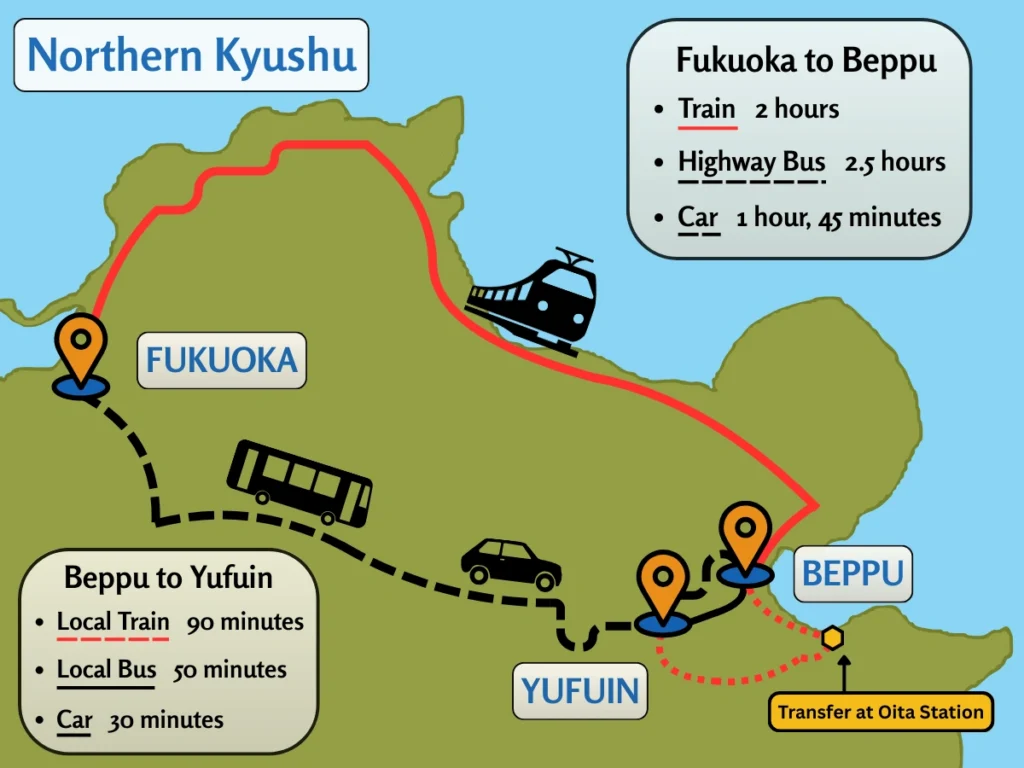
Here’s some travel options from Fukuoka to Beppu:
- Limited Express Train (Sonic): 2 hours from Hakata Station
- Highway Bus: 2.5 hours from Nishitetsu Tenjin or Hakata Bus Terminal
- Car: 1 hour, 45 minutes from Hakata
If you’re traveling primarily by train, you should definitely consider getting a JR pass.
The JR pass offers you unlimited rides on most trains (including the Shinkansen), buses, and ferries operated by Japan Railways (JR) for a set amount of time.
- If you’re exploring the whole country, you can grab the JR Whole Japan Rail Pass.
- If your adventure revolves around Kyushu, the regional JR Kyushu Rail Pass is the perfect (and cheaper!) option. You can even purchase a North or South Kyushu pass depending on what cities you’re visiting.
We decided ‘Hey, why not take the bus there and then get the train back?’
So on a chilly Friday morning in February, we packed our bags and took the bus to the Nishitetsu Tenjin Station.
Note to self: Definitely do research in advance when doing anything involving logistics!
We realized when we got there that the station was huge and we had no idea where to find where the highway buses departed from. We finally, finally got on an elevator to the third floor bus terminal, and when the doors opened, lo and behold the departure and arrival platforms for buses heading to different parts of Kyushu. We made our way to the gate for the earliest departing bus headed to Beppu.
Tim got me an iced matcha while we were waiting. And as I sat there, enjoying my iced drink and scrolling social media, Tim (the clearly more responsible one) decided to go to the ticket counter just to double check if we needed anything before departure.
The “Almost” Fail: We assumed we could just tap our IC cards and hop on the bus (like what we’ve done for most of our Japan bus rides). Wrong. Apparently, we were supposed to get tickets and seats for the highway bus well beforehand, and as it stood, there was only one ticket left.
It’s really not the end of the world. There are more buses departing for Beppu at later times.
Thankfully, the kind station agent that Tim talked to suggested that we ask the bus driver if he had any available seats. Luckily for us, he did have two seats available – the priority seats at the very front. It just so happened that no one needed them.
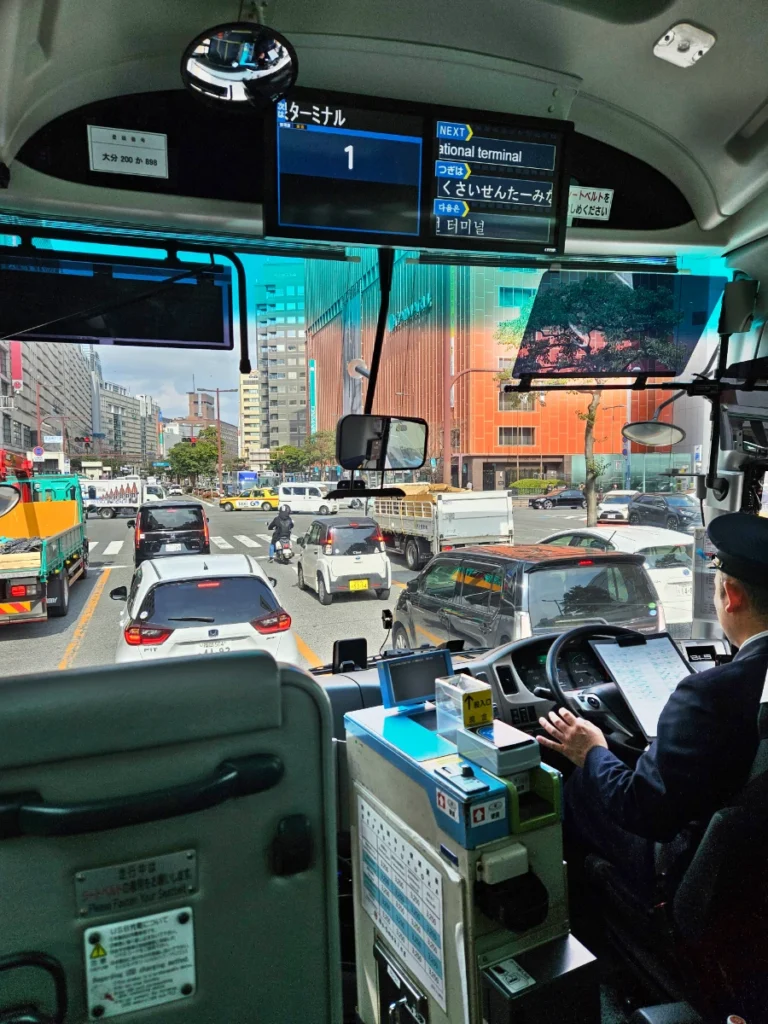
The ride was surprisingly smooth, scenic, and had a very clean toilet (hello iced matcha).
Beppu: The City of Steam
I knew we were nearing Beppu when I saw a city covered in steam. Steam rising from the ground, billowing between buildings, and hovering over the city. It’s nothing I’ve seen before.
Beppu is so rich in geothermal activity and has so many hot spring vents that you can find onsen at every turn. The guesthouse we stayed in, J-Hoppers Beppu Guesthouse, didn’t have hot springs of its own, but it offered free vouchers to use at a public bath house a minute’s walk away.
Strolling Beppu Park
A 20-minute walk from our guesthouse is Beppu Park, a peaceful park with winding paths, a bamboo grove, cherry and plum blossom trees, and mountains in the background. We visited the park shortly after arriving in Beppu and it was the perfect place to stretch our legs after hours on the bus.
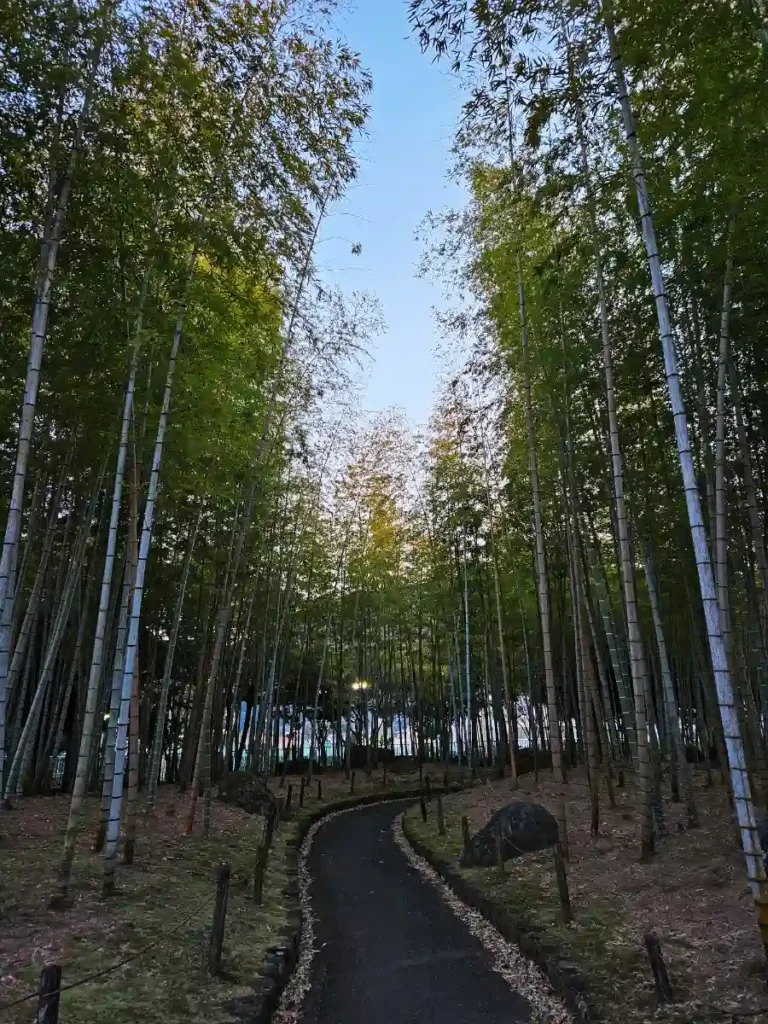
We met a fellow traveler from Chicago (who coincidentally stayed in our guesthouse as well) who was traveling Asia by bicycle. He had biked all around India, made his way through Japan, and was planning to catch a ferry to Busan, Korea from Fukuoka.
We spent the time exploring the park, discussing what we missed from home, and how much better the ice cream served at Japan’s McDonalds was compared to the US version.
Visiting the Seven Hells of Beppu – Beppu Jigoku
If you go online and you look up ‘Things to do in Beppu, Japan’, the top search option is going to be visiting the Seven Hells of Beppu. These hells (jigoku) are beautiful hot springs that are so hot they’re definitely not meant for bathing.
The Seven Hells are located in two areas of Beppu, the Kannawa and Shibaseki districts.
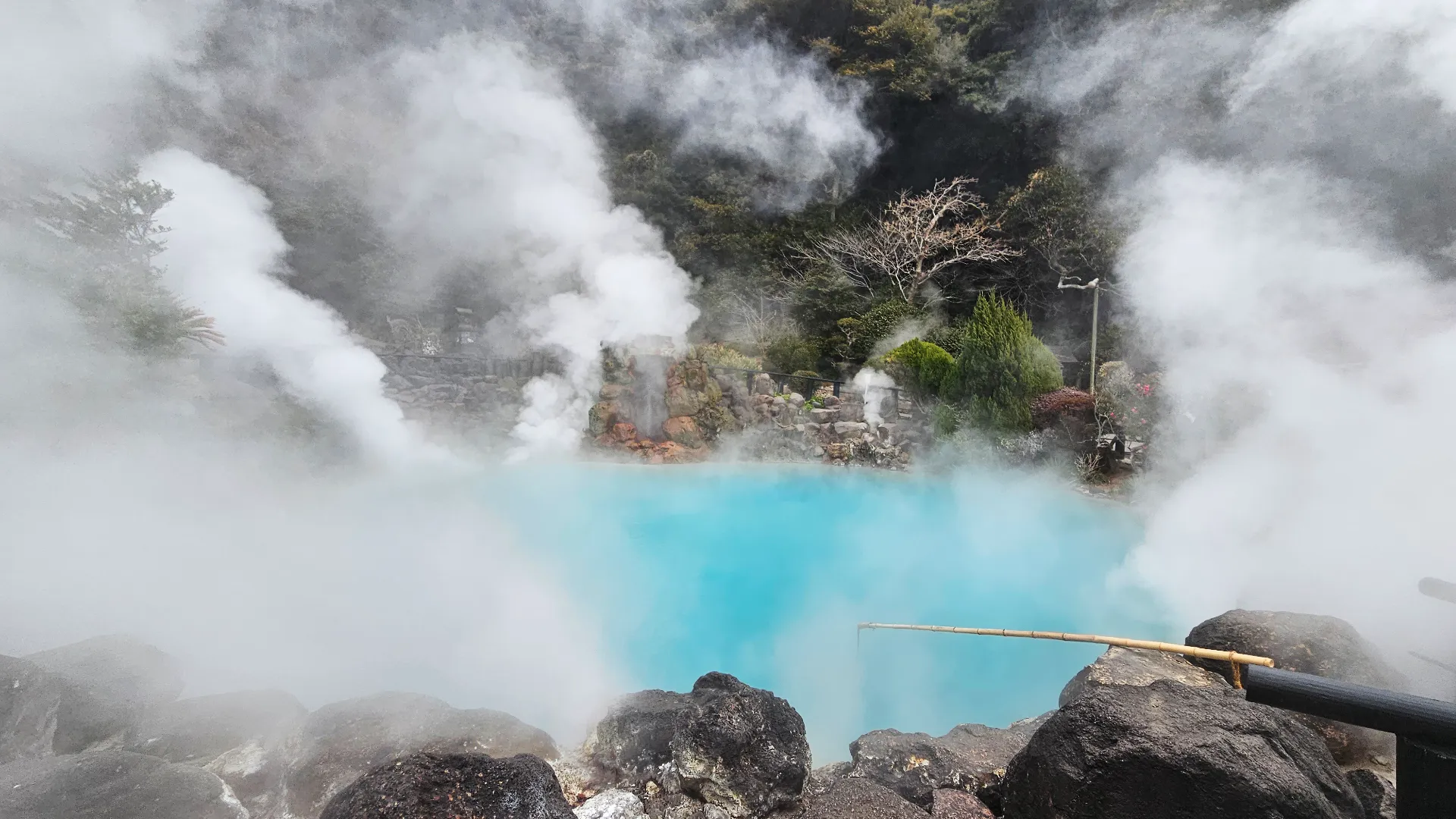
In Kannawa district, there’s Umi Jigoku (sea hell) with its vibrant azure water, Shiraike Jigoku’s (white pond hell) milky green pond, mud bubbles formed from the boiling mud pools of Oniishibozu Jigoku, Oniyama Jigoku which has crocodiles on the grounds, and Kamado Jigoku (cooking pot hell) where visitors can drink hot spring water and enjoy foot baths.
In Shibaseki district you can find Chinoike Jigoku’s (blood pond hell) hot, red waters and Tatsumaki Jigoku’s geyser that erupts every 30 to 40 minutes.
Tim and I got to Umi Jigoku from our hostel by bus, and I could tell that this was going to be a busy attraction. The bus was packed and we were met with traffic from tour buses as we got closer to the destination.
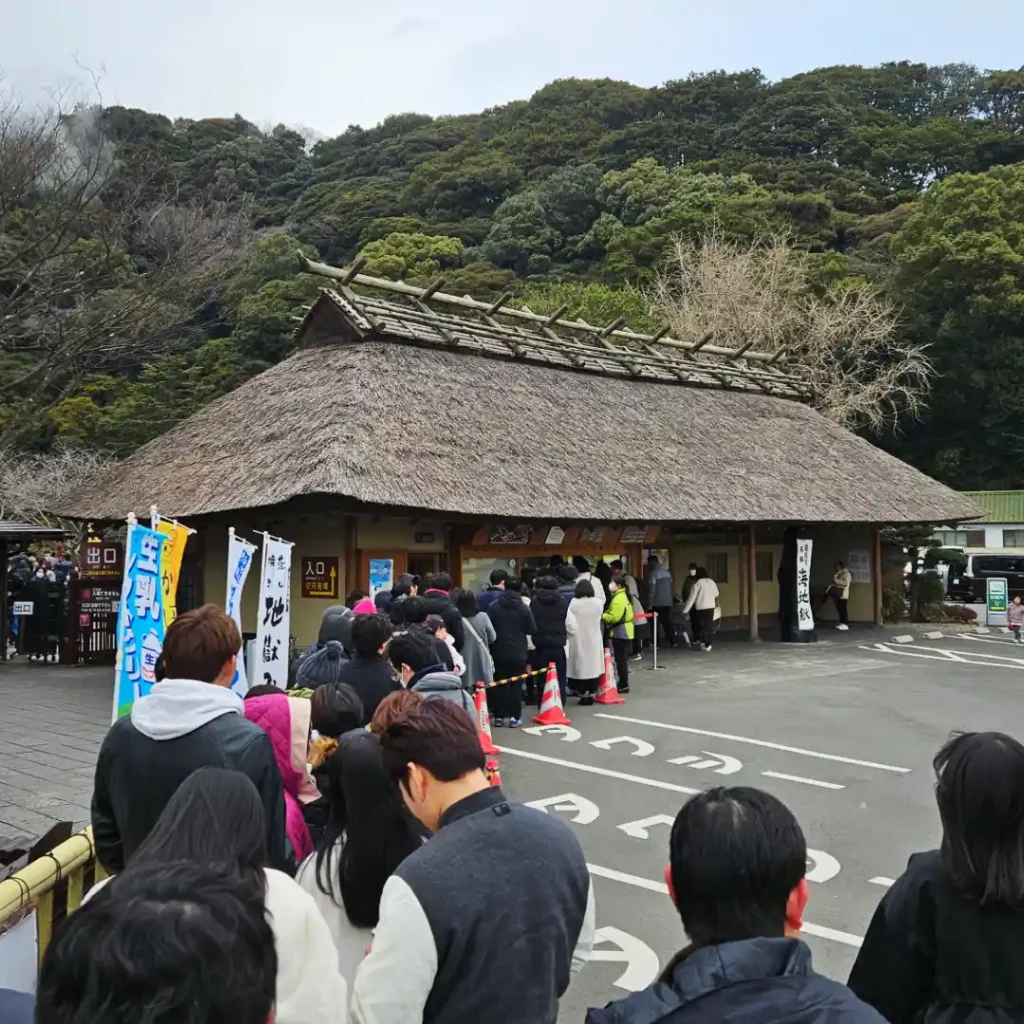
By the time we arrived, there was already a line of people queuing to buy a ticket – you pay an entrance fee of ~¥400 per hell, or you can buy a pass to visit all of them for ~¥2,200.
As we walked past the entrance gates, I was pleasantly surprised to see that there was more to the place than the sea blue hot spring it’s named after.
As you enter, you’re greeted by this large tranquil pond surrounded by greenery and backdropped by the steam rising from the hot spring. Follow the path through the pond and you finally make it to Umi Jigoku where the water is Gatorade blue and the steam rising from the waters is so warm that I was starting to sweat.
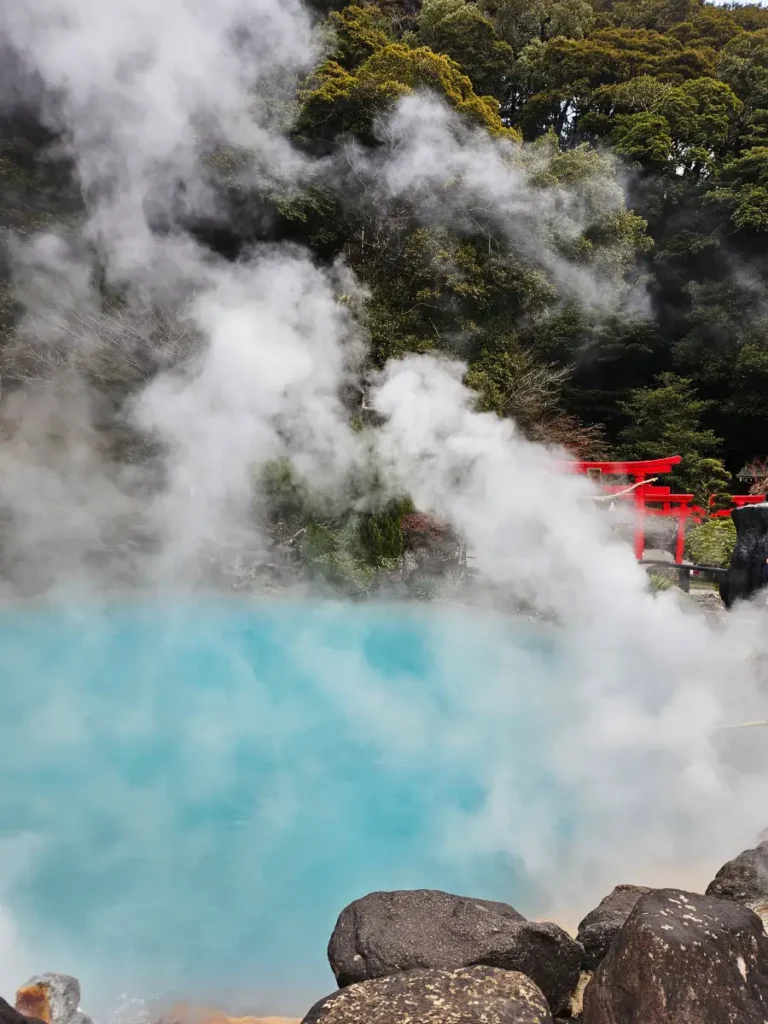
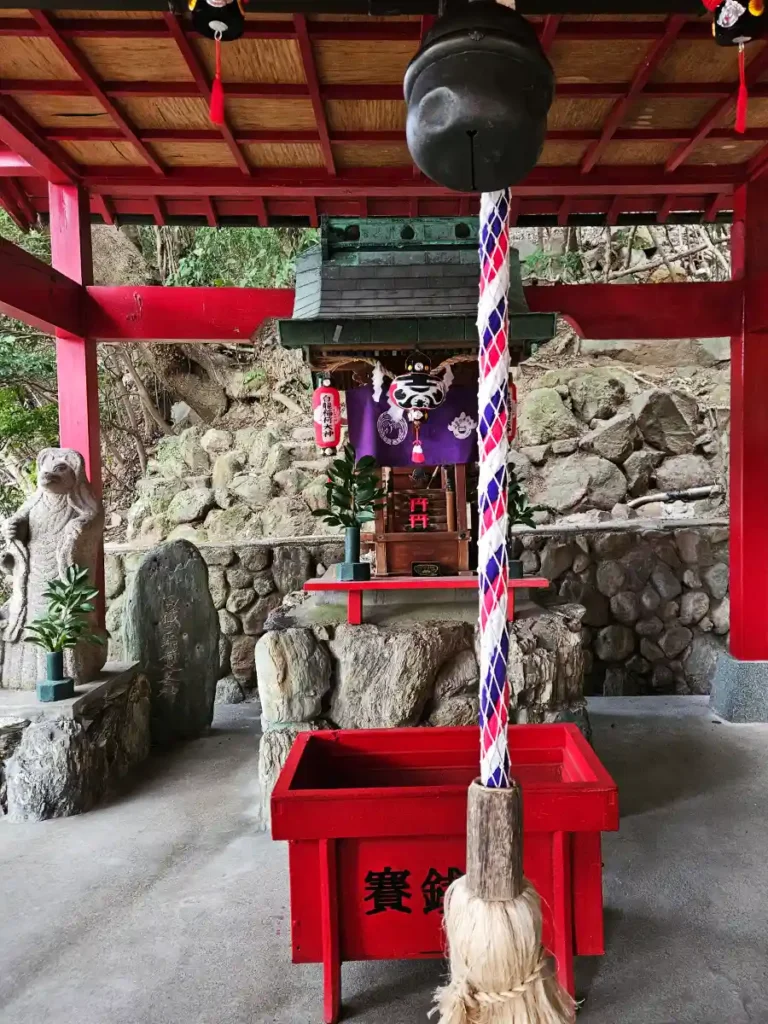
We climbed up the steps to Gallery Ao, a small gallery providing information on the history of Umi Jigoku. The terrace of the gallery also serves as an observation deck to see the hot spring from above. If you look through the thick steam over the hot springs, you can see bright red torii gates that are the start of a short path leading uphill through the trees to a shrine.
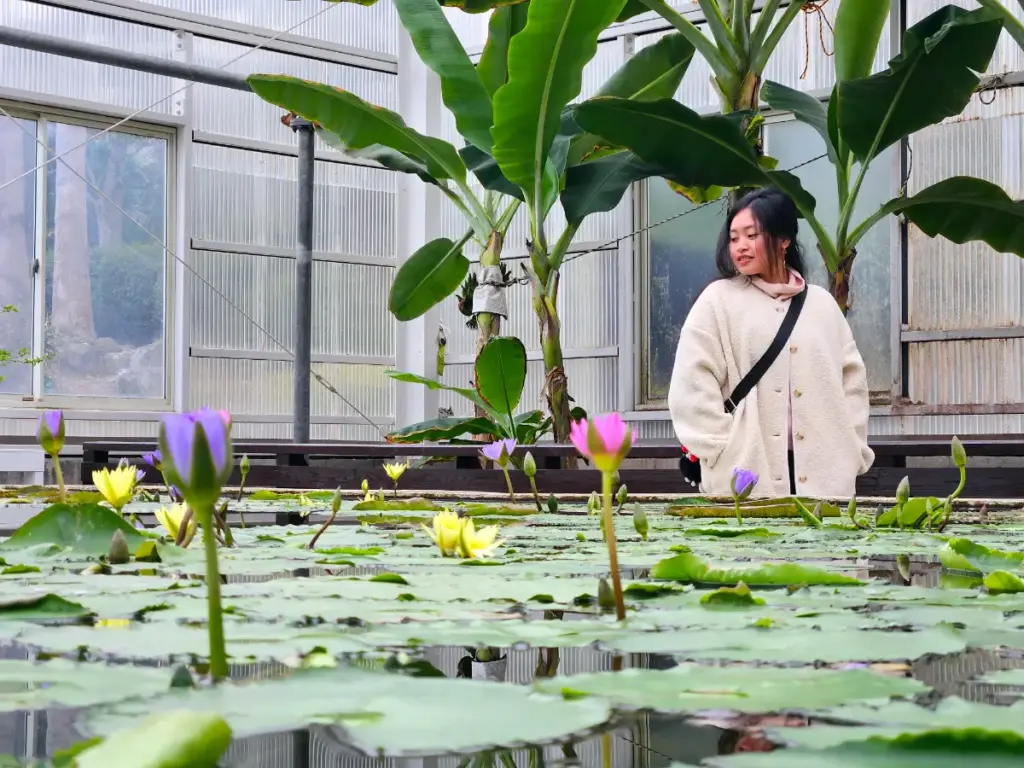
After taking the obligatory pictures by the pretty blue hot spring and a quick visit to the shrine, Tim and I wandered over to a greenhouse on the grounds with a sign that’s English translation stated ‘Hell emitting gas use greenhouse’. Inside the greenhouse, lining all four walls, were tropical plants and flowers and bonsai. And dominating the middle of the room was a pond filled with water lilies.
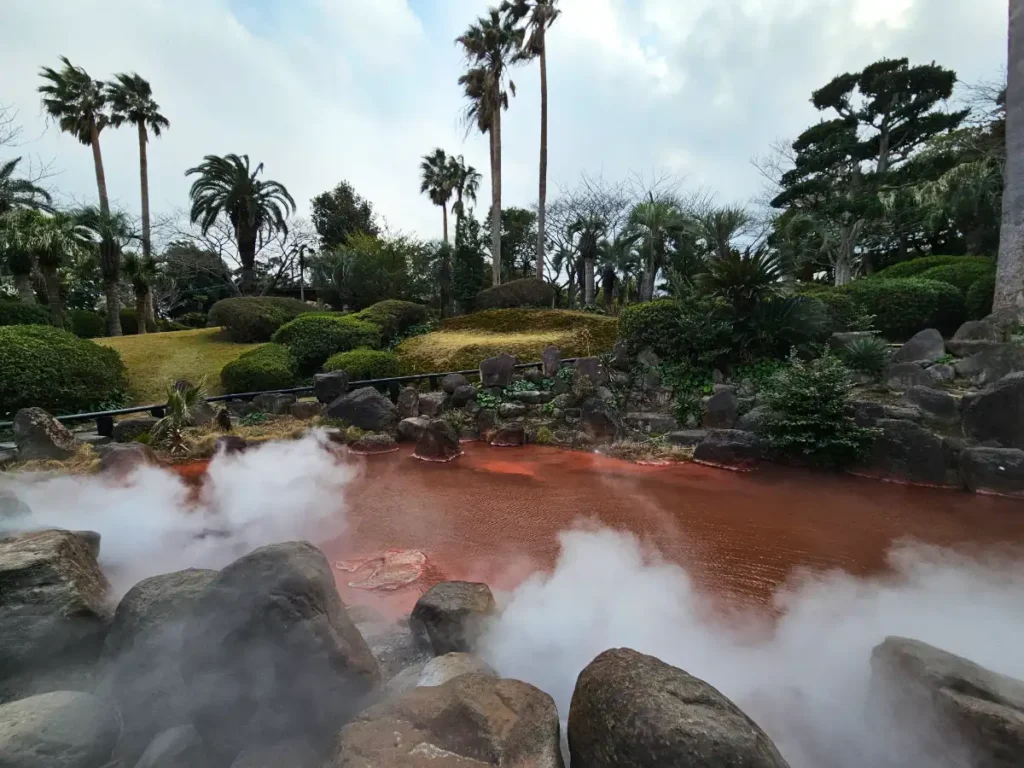
Close to the greenhouse is another hot spring, this time a rusty red, called Akaike.
As you make your way down the path back to the entrance, you pass by a foot bath where you can soak your feet in hot spring water (don’t worry, it’s not boiling lava hot) to relieve fatigue.
In all honesty, Tim and I opted not to visit any of the other hells aside from Umi Jigoku. I’m sure it would have been fun, but we were much more interested in the next part of our itinerary – onsen.
Relaxing at Hyotan Onsen
A 15-minute walk from Umi Jigoku, passing stalls selling steam cooked corn, through streets with steam seeping from cracks, and past shops selling soft serve is Hyotan Onsen.
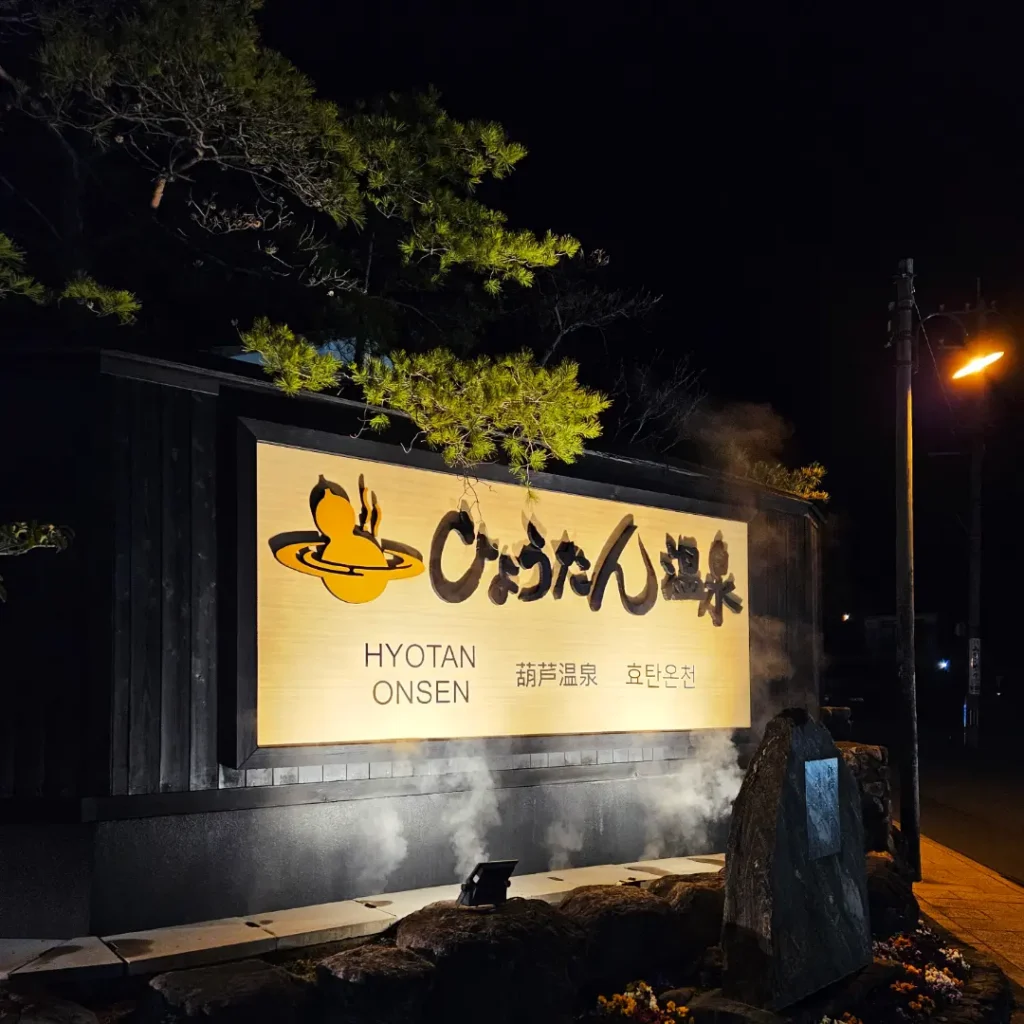
Founded in 1922, hot spring water flows through the facility, providing water and steam for its many baths, and heating the sand for sand baths.
Like in many bath houses in Japan, men’s and women’s public baths are separated. Present in each area are numerous indoor pools, open-air baths surrounded by rock walls, and steam and waterfall baths.
The facility also offers private baths and sand baths.
And when you’re hungry after your bath, there’s a restaurant onsite that serves food cooked in the steam of the hot springs (a special local cuisine in Beppu known as jigoku mushi).
Upon walking into the facility, Tim and I stopped at a vending machine to get tickets for the public bath (we didn’t make a reservation for the private baths and they were all booked by the time we got there), then traded those tickets at the front desk for yukata and slippers.
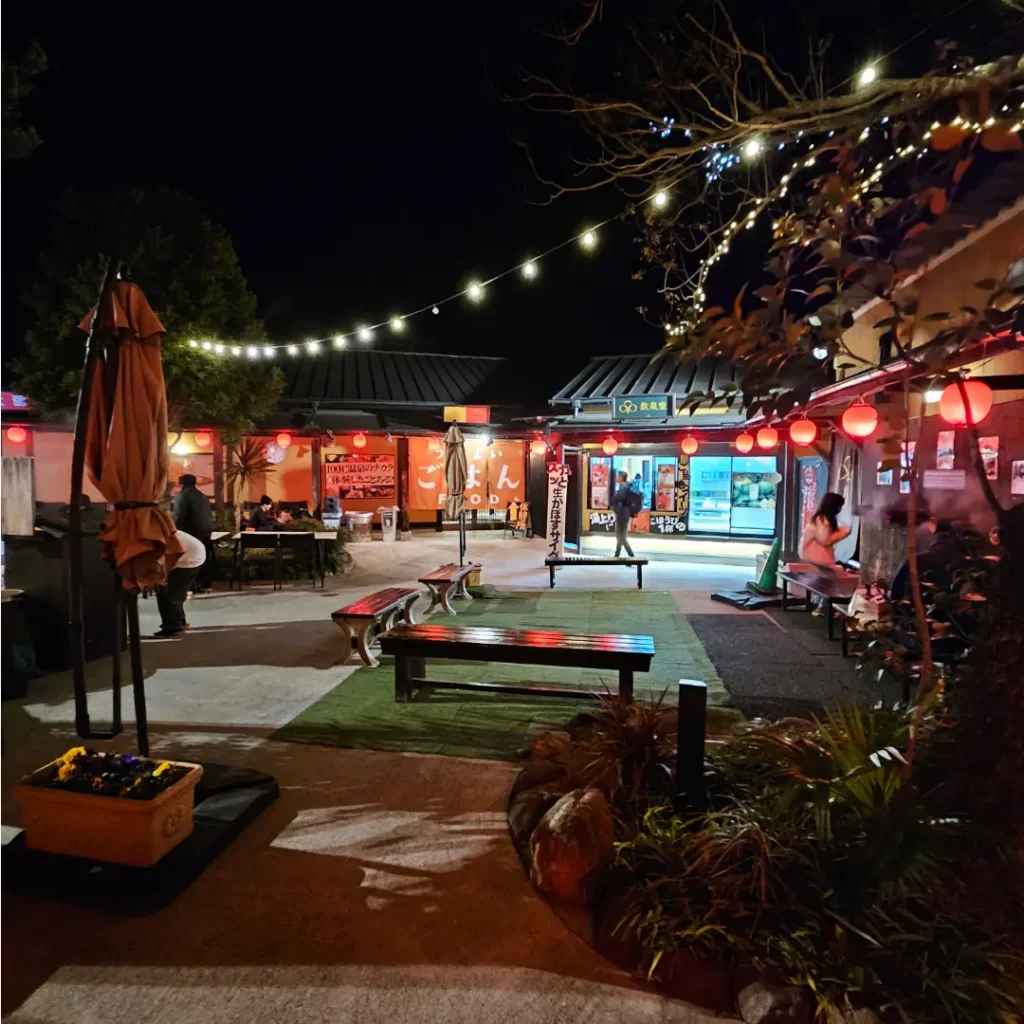
We then walked into a courtyard with benches and a tray of onsen eggs available for purchase. This is where we split up, him heading for the men’s and me to the women’s bath.
After a thorough shower and putting my wet hair up, I spent the next few hours alternating between hot pools of varying temperatures, massaging my shoulders with the streams of the waterfall bath, sitting in the steam baths, and relaxing in the open-air baths where my body was submerged in hot water and the cold winter air on my face kept me from overheating.
And after my bath, after I showered and dried off my hair and changed back into my clothes, Tim and I reconvened in the courtyard and enjoyed bottles of milk from a vending machine. Truly delicious and so refreshing.
We spent five hours at this onsen.
Where to Eat in Beppu
Literally the first thing that Tim and I did after getting off of the bus in Beppu was go to a 7-Eleven. Not really a unique experience. Probably every single tourist visiting Japan does this.
So we get ourselves some kind of bread roll, a fried chicken from the hot foods section – we combined the bread and chicken to make our own sandwich- and a strawberry and whipped cream sandwich.
And as we were standing outside the 7-Eleven eating our sandwiches, we noticed this little shack with two ice cream cone figures by the entrance. We noticed it because the most mouth-watering fried chicken smell was wafting from it. It smelled so good. So, with full bellies, we made our way to the little shop to investigate.
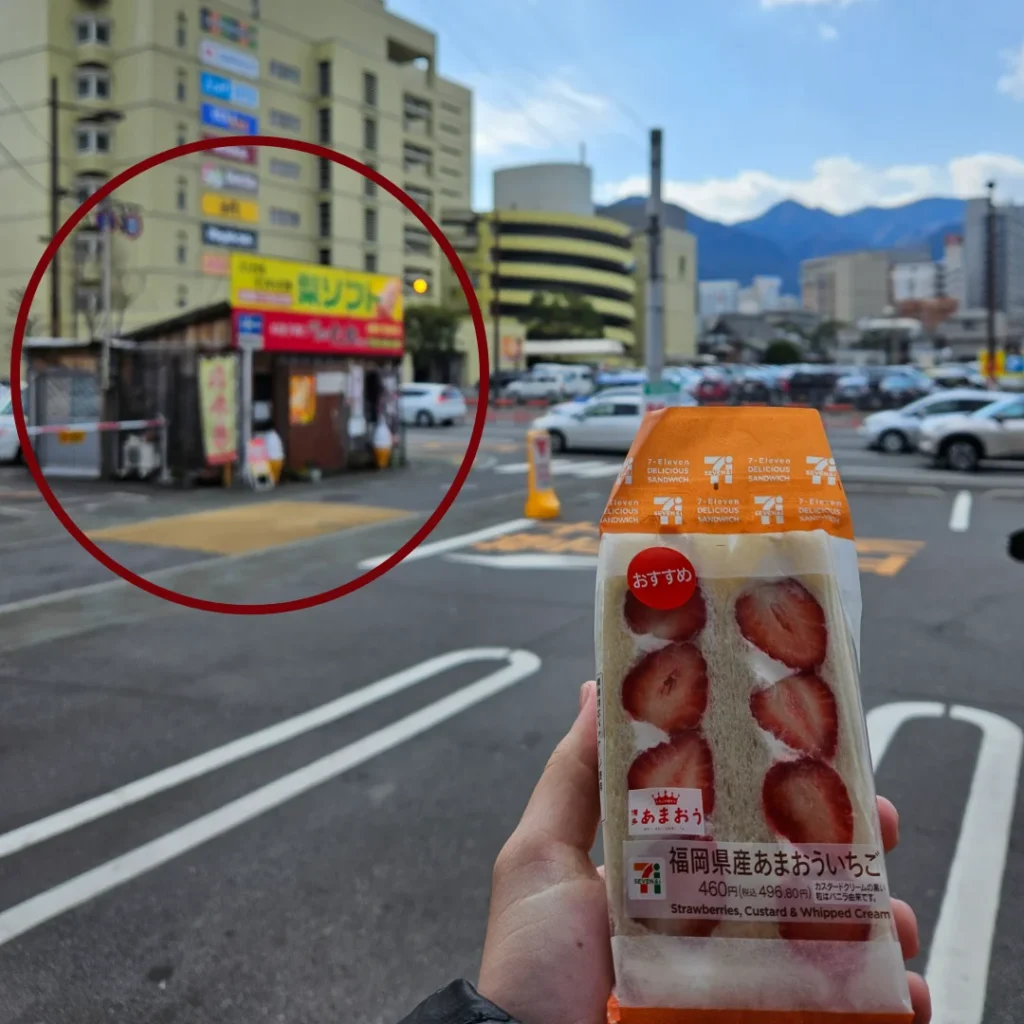
As it turns out, Takachan sells yakitori, karaage, and bentos for very reasonable prices. We added the shop to our Google pins to visit when we weren’t quite so full.
We visited the very next day for a karaage bento.
The food was made fresh, served piping hot, and the chicken was so juicy and delicious. We took the bento to a nearby park to eat and it was so delicious we forgot to take a single photo.
That night, Tim and I were craving tendon (tempura rice bowl) so we visited Toyotsune for their tendon set. The sashimi was so fresh, the soup comforting on a cold winter night, and the tempura so crisp and light. So perfect.
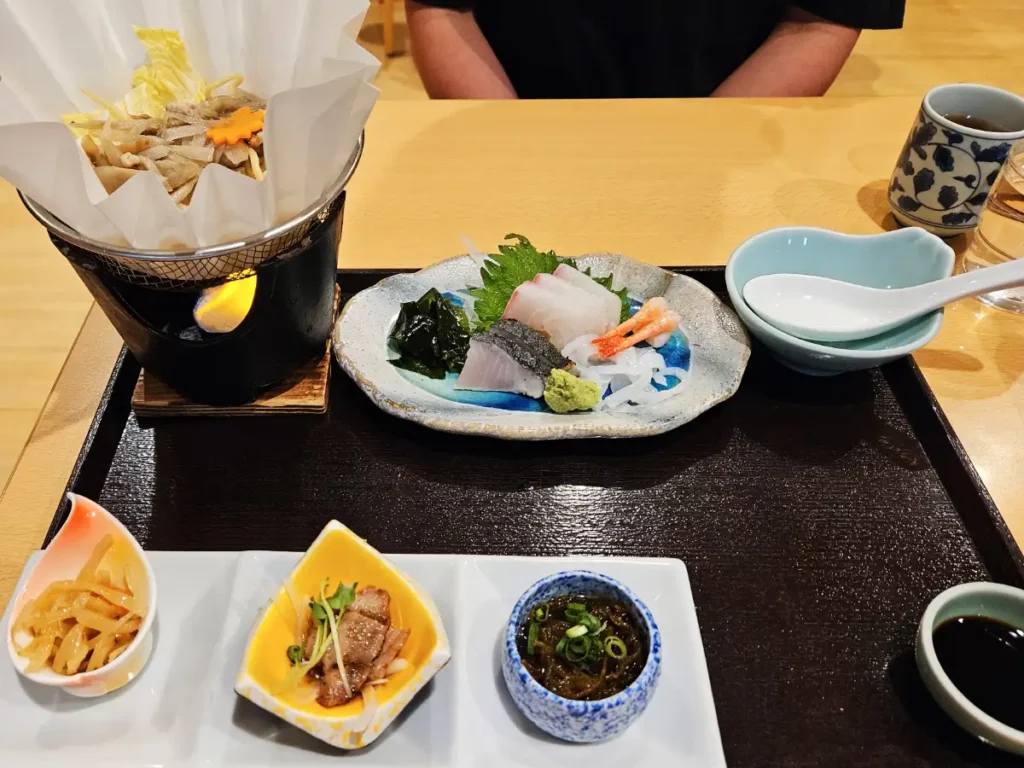
While eating, we met Michael, a traveler from Taiwan. We had a great time chatting over dinner, so we all decided to migrate to a coffee shop to continue talking.
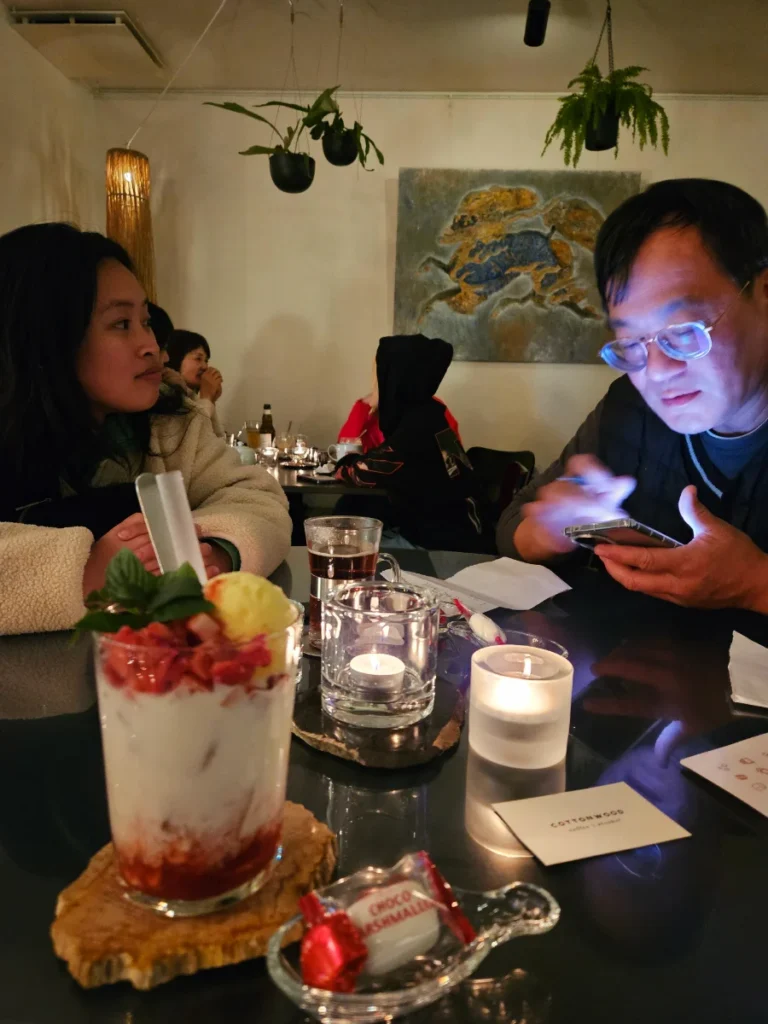
Now he might not look it, but Michael is an older man who is very particular about his coffee shops. So the quick migration to a nearby coffee shop turned into a Goldilocks quest to find THE coffee shop. The music was much too loud in one – not conducive for talking. The lighting too bright in the next – too easy to see wrinkles and fine lines. Finally we happened on the perfect shop. Cottonwood Café with its moody lighting, pretty drinks, and a gentleman with his guitar playing live music.
It was at that coffee shop, listening to the strums of the guitar and enjoying sips of tea (and a strawberry yogurt for Tim) where Michael shared with us tales of his travels all around Japan, his visits to Europe, and his plans of future adventures. He also gave us a handwritten list of places we needed to visit in Taiwan.
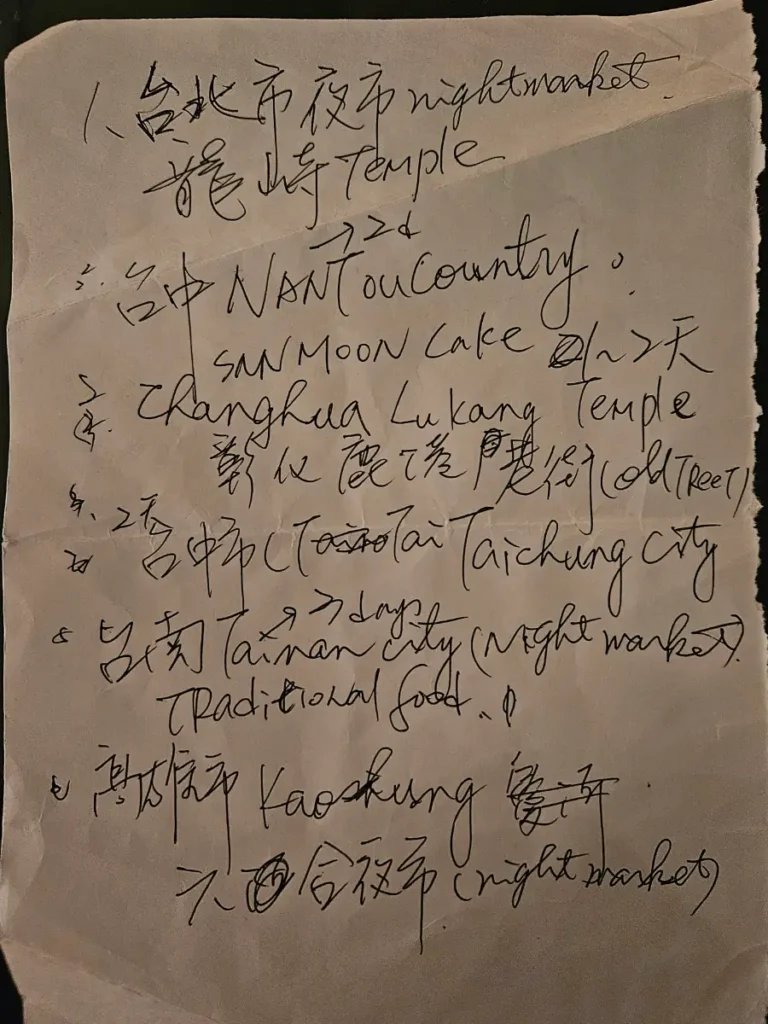
We wrapped up the night with hugs and promises to reach out if we ever made our way to his part of the world.
This is why we slow travel: the best memories are the people you meet when you aren’t in a hurry.
Traveling From Beppu to Yufuin
Here are some ways to travel from Beppu to Yufuin:
- Train: 90 minutes, starting at Beppu Station with a transfer at Oita Station
- Local Bus: 50 minutes on Bus 36
- Car: 30 minutes
Yufuin: The Charming Escape
It was around 1:30pm when we finally arrived in Yufuin. The bus ride over from Beppu had been cramped and the drive windy.
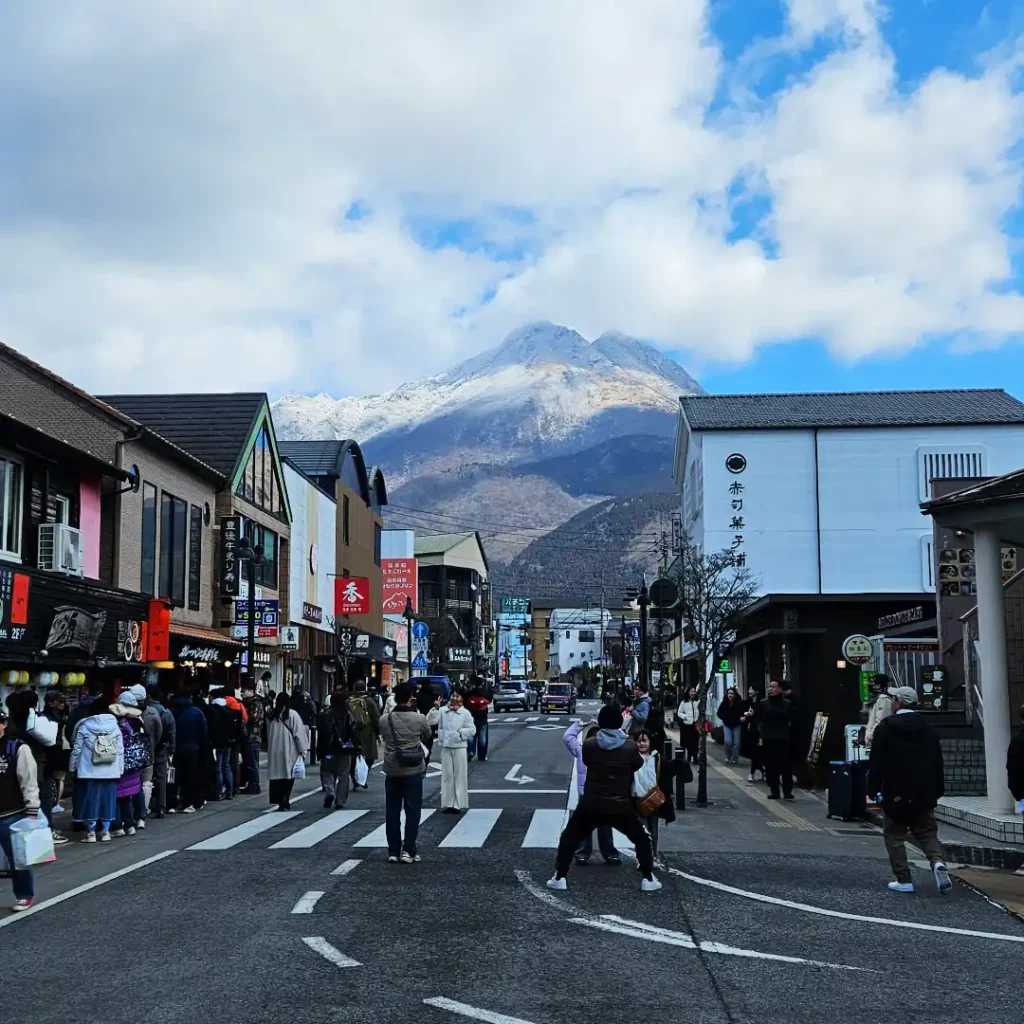
But when we finally got off at the stop, we were met with a charming town, people walking around with hands shoved in their pockets to hide from the cold and big smiles on their faces, and tourists in the middle of the street taking photos with Mount Yufu in the background.
Onsen Hopping
Yufuin is known as an onsen town. It’s an amazing place for relaxation, where you can soak in the hot waters of its numerous hot spring resorts surrounded by tranquil nature.
And you don’t have to stay at expensive resorts to have a relaxing time.
In fact, we stayed in an inn called Yufuin Akarinoyado that offered public baths and a private open-air bath on reservation. Our reservation was at 5:30pm, so we decided to explore in the meantime.
We didn’t get very far.
Five minutes into our exploration, we found ourselves at Ryoso Makibanoie, a ryokan (traditional Japanese inn) that also offers public use of their onsen.
We couldn’t help ourselves. Yufuin is an onsen town (as I said). Onsen hopping is the thing to do here and I won’t have anyone tell me otherwise.
So we got two tickets for the use of their large open-air baths.
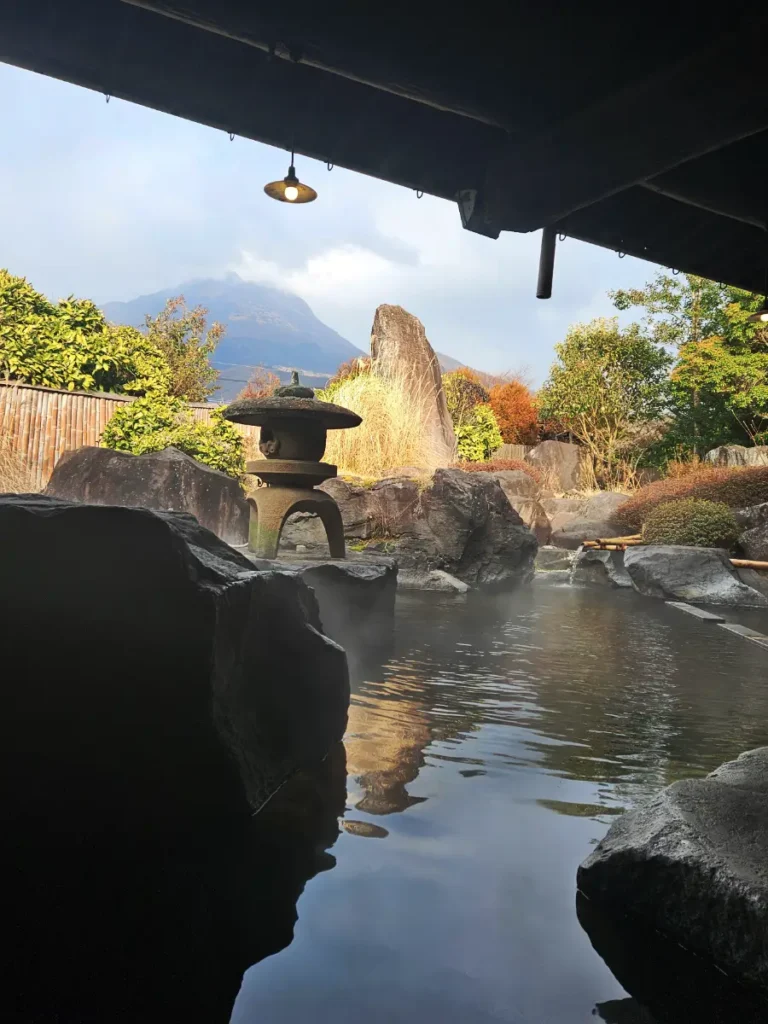
The bath was definitely a highlight. The calm water is surrounded by large rocks, tall grasses, and trees, with a view of the mountains nearby. A stone lantern sits on one of the large rocks.
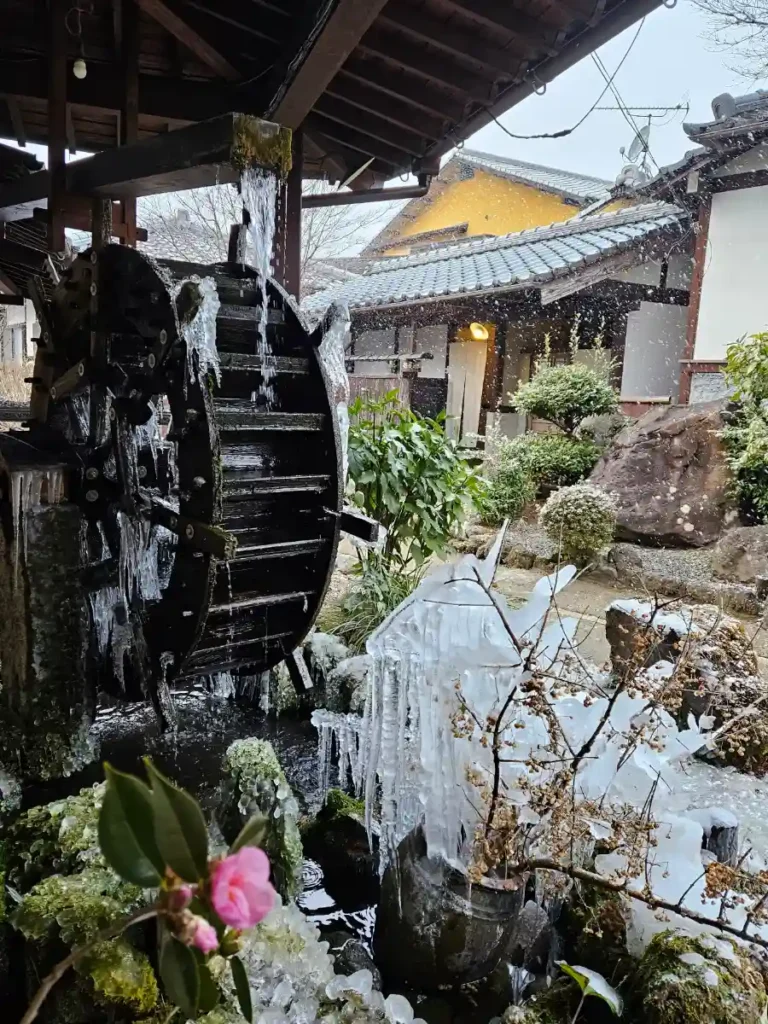
And when the snow started falling while I sat soaking in the hot spring waters, well that was just magical.
I’m definitely booking a stay at Ryoso Makibanoie the next time I visit Yufuin.
Hours later, we finally make it back to our accommodation, just in time for our reservation.
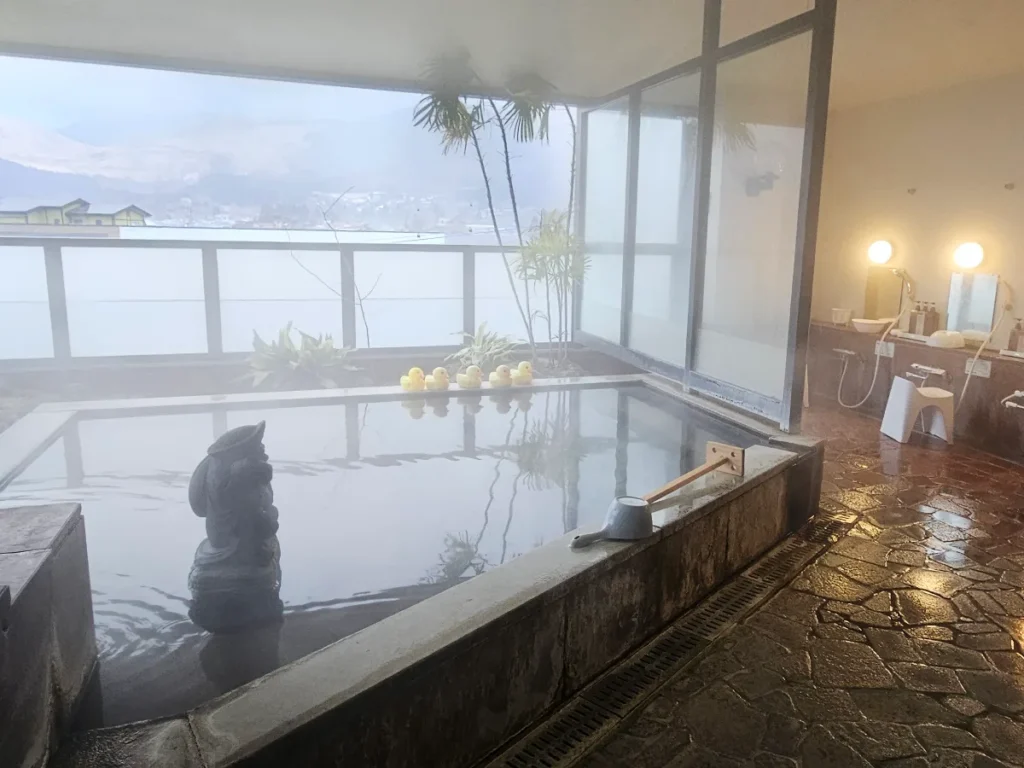
The bath at the inn isn’t a full open-air bath. It’s located on the 3rd floor of the building, with a large, stone bath filled with steaming, natural hot spring water and a panoramic view of the surrounding landscape from the partial wall. And the second-best part of the bath (the first being that it’s private and Tim and I can soak together) are the rubber ducks in a line at the edge of the stone bath.
Lake Kinrin and Yunotsubo Kaido
Early the next day, before the sun’s melted the light dusting of snow on the ground and on Mount Yufu, Tim and I took a stroll through fields, across bridges, and past streams to Lake Kinrin.
In the early mornings, mist covers the surface of the lake. We walked the paths going around the lake, stopping to take photos of birds in the water and the torii gate by the shore.
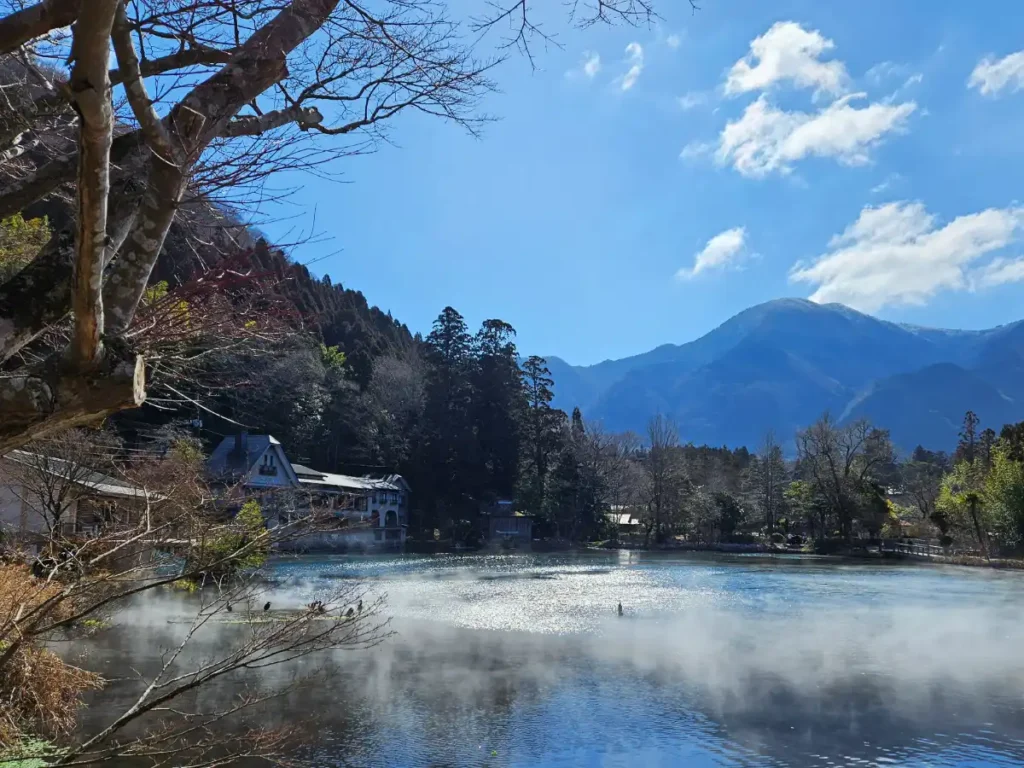
On the way back from the lake, we decided to walk down Yunotsubo Kaido, a street that runs from Yufuin Station to Lake Kinrin. It’s a street lined with cute shops selling handmade goods and souvenirs, and food stalls at seemingly every step. It only takes around 20 minutes to walk the whole street, but you could spend hours looking through shops and exploring the side streets.
Tim got me a curry bun from a shop called Agebiyori, and it was the perfect snack for the cold day. Deliciously crispy, with piping hot curry so flavorful inside.
Riding the Yufuin no Mori
To get back to Fukuoka, we decided to take the train. And not just any train. We made reservations for the Yufuin no Mori, a sightseeing limited express train that takes a scenic route between Fukuoka, Yufuin, and Beppu.
It’s more expensive than a regular train, but the Yufuin no Mori is its own experience. It was just so pretty. The design is inspired by the forest (which is mori in Japanese), with a green exterior and green, gold, and wooden elements in the interior of the train.
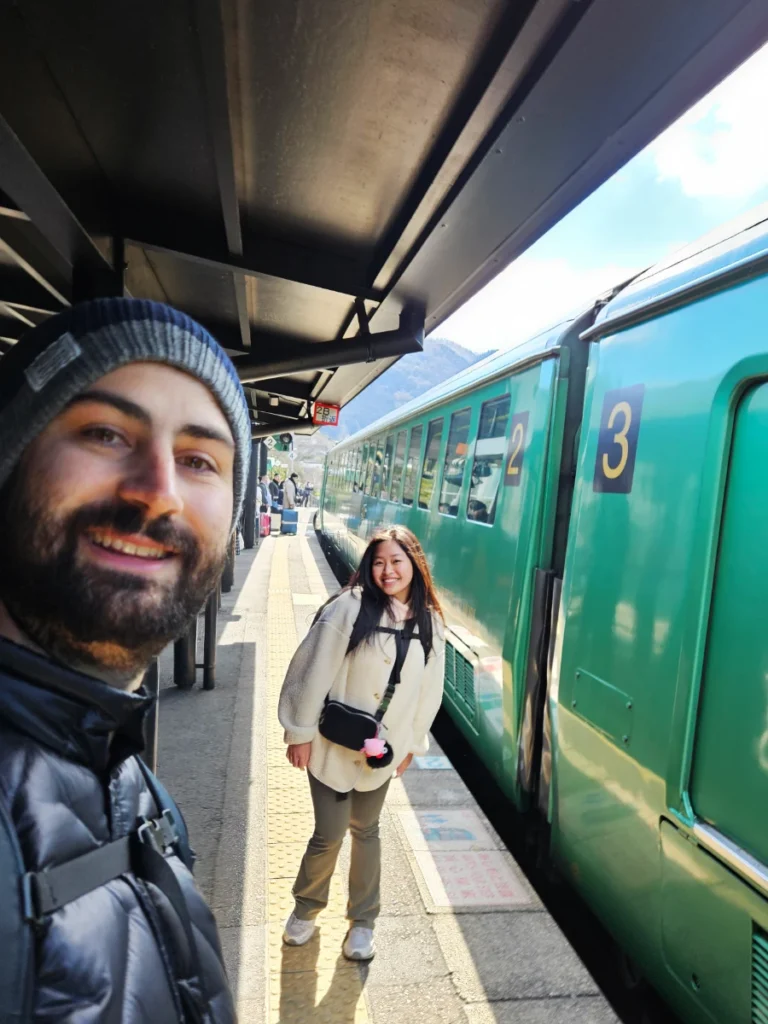
You can look out at the scenery from the large windows, relax and have a drink at the lounge, and purchase food and drinks at the dining cart and bar.
If you want to experience this ride yourself, I highly recommend checking the schedule and booking your Yufuin no Mori tickets in advance.
Just be careful when you’re selecting your ticket. The sightseeing train is called Yufuin no Mori. There are other ticket options for regular trains that take the same route.
We got drinks and ekiben (train bento) onboard, and played card games when we weren’t admiring the beautiful Japanese countryside. The train passed mountains and rivers and even slowed down for the Jion-no-taki waterfall.
In seemingly no time at all, we were back in Fukuoka.
Planning your next trip but don’t know where to start?
Join our newsletter to get our free Slow Travel Toolkit!
It includes our essential pre-departure checklist, a budget guide and tracker, and the packing list we used for 15 months of travel.
What Beppu and Yufuin Taught Us About Being Present
Although we only had four days to explore Beppu and Yufuin (we typically like to devote at least a week to get to know the area), this trip still felt like the opposite of a “check-box” itinerary.
For us, slow travel is about being present.
It’s about meeting a stranger at dinner and spontaneously going on an adventure with them to chase the perfect coffee shop.
It’s the feeling of cold winter air on your cheeks while your body is submerged in volcanic water, relaxed and unhurried because you’re not worrying about being on time for the next activity.
It’s realizing that “logistical failures” (or “almost-a-failure” because we did end up on that bus) don’t mean that the day is ruined. They’re just the start of a new story.
Tips for Fellow Travelers
Here’s a few tips for when you’re planning your Beppu and Yufuin getaway:
- JR Pass: If you already have one, use the train – it’ll be more cost-effective.
- Driving: You must have an International Driving Permit (IDP) to rent a car in Japan. Also, pay attention to toll roads that you might encounter as you drive between cities.
- Stay in a ryokan. Beppu and Yufuin are beautiful onsen towns and they’re great places to try staying in a ryokan with an onsen.
- Be flexible. It’s great to be prepared and have activities lined up for your trip, but be flexible. Allow yourself to spend more time in a hot spring if you want to. Stay at the cafe you’ve been eyeing because you like the vibe.
Conclusion
Our weekend in Beppu and Yufuin reminded us of why we loved slow travel. We went for the hot springs, and we came back with the memory of a guitar playing in a dimly lit café and the taste of a steaming curry bun on a winter morning.
Whether it’s soaking in a bath full of rubber ducks or sharing stories with a stranger from across the sea, the best experiences happen when you stop watching the clock and start letting yourself be present in the moment.
Have you ever let a local’s recommendation completely change your travel plans? Share your stories in the comments!

Leave a Reply